
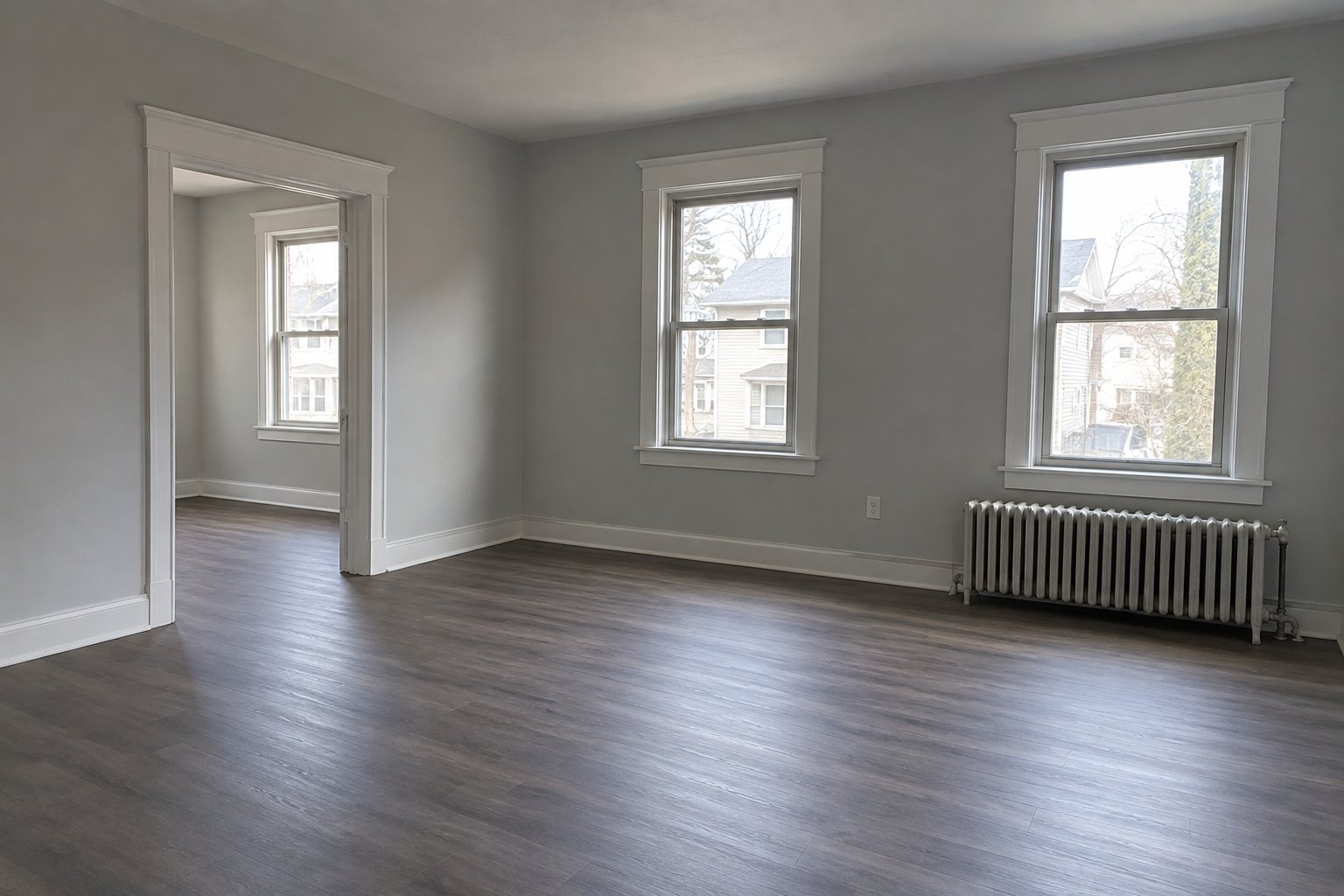
Turnover is where rental math gets decided. Every day a unit sits empty costs rent, and every repair skipped between tenants tends to come back later as a bigger bill. The owners who handle it well aren’t the ones who fix everything — they’re the ones who fix the right things in the right order, in one coordinated pass.
Below is the punch list we work from on investor and rental turnovers across Wayne County, northern Cayuga County, and western Oswego County, sorted by priority rather than by room.

Tier 1: Water, Safety, and Anything That Gets Worse on Its Own
These are non-negotiable, and they are the items that quietly turn a turnover into a renovation if they wait another tenancy.
- Any active drip: supply lines, shutoff valves, tub spouts, P-traps under sinks.
- Failed tub, shower, and backsplash caulk, plus loose or missing grout in wet areas.
- Running toilets and worn flappers — cheap parts, real water bills, and a common complaint call.
- Soft spots in flooring near tubs and toilets, which usually mean water already got underneath.
- Loose railings, wobbly steps, and any exterior door that doesn’t latch and lock cleanly.
- Bath vent fans that don’t clear steam, which is the root cause behind most peeling paint and ceiling mold in rentals.
- Damp basement walls, musty smells, and downspouts dumping against the foundation.
Tier 2: The Items That Drive Maintenance Calls Later
None of these are emergencies. All of them generate phone calls once someone is living there, and each call costs a trip.
- Interior doors that rub the jamb or won’t latch, plus missing door stops.
- Cabinet hinges, drawer slides, pulls, and toilet seats — tighten or replace rather than defer.
- Worn or mismatched locksets and deadbolts; rekey or replace at the same visit.
- Slow drains cleared before move-in instead of at 9 p.m. on a Sunday.
- Outlets and switches with broken plates, plus smoke and carbon monoxide detectors with fresh batteries.
- Closet rods, shelves, and blinds anchored properly into studs or with real drywall anchors.

Tier 3: Cosmetic Work That Actually Moves Rent
Cosmetics come last in sequence but they are what a prospective tenant sees in the listing photos and the first ten seconds of a showing. The highest-return items are consistently the cheap ones:
- Patch, prime, and paint in one round — one color, one sheen, everywhere, so future touch-ups need no matching.
- Bathroom refresh over bathroom replacement: new caulk, regrout, fresh vanity hardware, a clean mirror and light fixture, new toilet seat.
- Consistent lighting: matching fixtures and the same bulb color temperature throughout.
- Trim repairs — split baseboard corners, missing shoe molding, and gaps that read as neglect in photos.
- Basement cleanup and a painted floor or finished storage area, which makes a unit feel larger for very little money.
Sequencing: Why the Order Saves More Than the Labor
The reason turnovers run long is almost never the repair list itself — it’s doing the work in an order that forces rework. A sequence that holds up:
- Walk the unit and write everything down before anyone starts.
- Fix water and safety items first, since those are the ones that can open up walls or flooring and change the rest of the scope.
- Do carpentry, doors, and hardware next, because they create patching work.
- Patch, prime, and paint in a single round after all wall damage exists.
- Install fixtures, blinds, and hardware last so nothing gets painted over or scuffed.
- Deep clean, then photograph — before any tools come back in.

What to Spend On, and What to Leave Alone
Two failure modes show up repeatedly on rental properties. One is under-investing — patching the symptom, skipping ventilation and drainage, and paying for the same repair every tenancy. The other is over-investing: finishes chosen for an owner-occupied home that won’t survive a few tenancies and won’t raise rent enough to pay for themselves.
The durable middle is boring and effective: solid-surface flooring that can be mopped, semi-gloss paint in wet rooms, standard-size fixtures you can source again in a hurry, and one paint color per property. Where a unit needs a real upgrade to reach the next rent tier, the bathroom is usually the place it pays off, followed by a usable finished basement. Kitchen updates can matter, but only after the water, safety, and bathroom items are handled.
Turning the Punch List Into One Visit
A written, tiered list is what makes a turnover a single scheduled pass instead of five trips. Bring it to a consultation with the tiers already marked, and it becomes obvious which items are same-visit work and which need to be scoped as a project. Veteran-owned and insured, TGM Contracting & Remodeling handles handyman and punch-list work, bathrooms, basements, investor and rental turnovers, and general remodeling across Wayne County, northern Cayuga County, and western Oswego County — with a lifetime warranty on our craftsmanship.
Related Reading
- Handyman Services
- Bathroom Remodeling
- Basement Remodeling & Finishing
- How to Choose the Right Bathroom Vent Fan: A Buying Guide
- Whole-Home Remodeling
- Project Portfolio
- Testimonials
Ready to Start Your Project?
Veteran owned & operated · Lifetime warranty on all craftsmanship
Financing Available
Check what you qualify for in 60 seconds — no impact to your credit score.
Ready to Start Your Project?
TGM Contracting & Remodeling — Veteran-owned, serving Wayne County, northern Cayuga & western Oswego County